
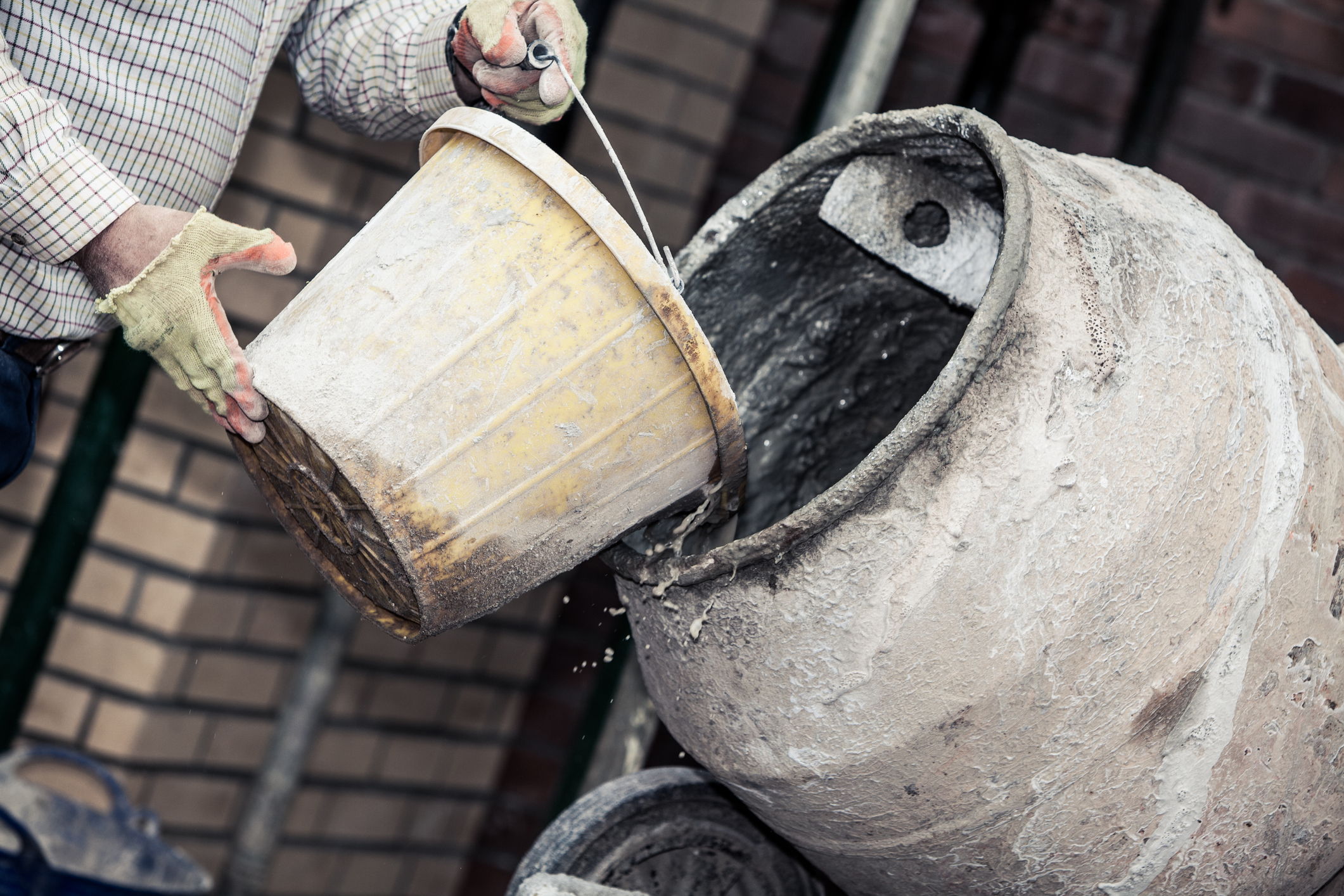


ACI defines grout as “a mixture of cementitious material and water, with or without aggregate, proportioned to produce a pourable consistency without segregation of the constituents.” Grout may also contain fly ash, slag, and liquid admixtures.
The terms grout and mortar are frequently used interchangeably but there are clear distinctions. Grout need not contain aggregate whereas mortar contains fine aggregate. Grout is supplied in a pourable consistency whereas mortar is not. Grout fills space whereas mortar bonds elements together, as in masonry construction.
Grout is often identified by its application. Some examples are: bonded pre-stressed tendon grout, auger cast pile grout, masonry grout, and pre-placed aggregate grout. Controlled low strength material (flowable fill) is a type of grout.
Grout is used to fill space or cavities and provide continuity between building elements. In some applications, grout will act in a structural capacity, such as in reinforced masonry construction. In building construction, grout can improve fire ratings, acoustic performance, blast resistance and the thermal mass properties of the building elements.
In projects where small quantities of grout are required, it is proportioned and mixed on site. The ready mixed concrete producer is generally called upon when large quantities are needed.

For masonry grout, ASTM C476 provides prescribed proportions by loose volumes that are convenient for small quantities of grout mixed on site. Alternatively ASTM C476 has provisions for establishing grout proportions on the basis of specified compressive strength. The specified compressive strength must be at least 2000 psi. Grout mixtures meeting the proportion table of ASTM C476 have high cement contents and tend to produce much higher strengths than specified compressive strength requirements of ASTM C476, ACI 530 or Model Codes. Two types of masonry grouts are defined in ASTM C476: fine grout with aggregates smaller than ⅜ inch (9.9 mm) and coarse grout that allows aggregate sizes up to ½ inch (12.5 mm). Choice of grout type depends primarily on the clear dimensions of the space being filled by the grout. Grouting of masonry construction should comply with the governing building code provisions. Information on grouts for masonry construction is available from the National Concrete Masonry Association (NCMA).
When grout is ordered from a ready mixed concrete producer, the specifications should be based on consistency and compressive strength. Converting loose volume proportions into batch weights per cubic yard is subject to errors and can lead to controversies on the job.
Specifications should address the addition of any required admixtures for grout. Conditions of delivery, such as temperature, time limits, and policies on job site addition of water, should be specified. The contractor will need to ensure that the grout consistency is sufficiently flowable. Testing frequency and methods of acceptance must be covered in specifications.
The consistency of grout affects its strength and other properties. It is critical that grout consistency permit the complete filling of void space without segregation of ingredients.
Consistency of masonry grout may be measured with a slump cone (ASTM C143), and slumps of 8-11 in. are generally required for both fine and coarse grout. Self-consolidating grout is a highly fluid and stable grout mix that does not require consolidation. These grouts are tested using the slump flow test, ASTM C1611, which measures the spread of the grout using the slump cone.
For other types of grouts without aggregate, or only fine aggregate passing a No. 8 sieve, consistency is best determined with a flow cone (ASTM C939). For flow values exceeding 35 seconds, use the flow table in ASTM C109, modified to use 5 drops in 3 seconds.
Masonry grout (“blockfill”) for strength tests specimens should be cast in molds formed by masonry units having the same absorption characteristics and moisture content as the units used in construction (ASTM C1019). Never use nonabsorbent cube or cylinder molds for this purpose.
Strength of other types of grout is determined using 2 in. cubes per ASTM C942. Method C942 allows for field preparation, recognizes fluid consistency, and also affords a means for determining compressive strength of grouts that contain expansive agents or grout fluidifiers. This is extremely important since “expansive” grouts can lose substantial compressive strengths if cubes are not confined. However, cylindrical specimens (6 x 12 in. or 4 x 8 in.), may give more reliable results for grouts containing coarse aggregate.
Special application grouts often require modification of standard test procedures. All such modifications should be noted in the specifications and discussed prior to the start of the job.